As metal 3D printing advances towards mass production, how can efficiency be further improved once single-machine printing speeds have reached their limits? UnionTech has identified the complexities of material flow in production: manual cart pushing, cross-station waiting, powder exposure risks, and scheduling bottlenecks for powder removal and heat treatment. These "hidden costs," which are difficult to measure directly, are becoming new bottlenecks limiting capacity expansion for mold factories.
How Can Metal 3D Printing Evolve from Discrete, Stand-Alone Systems to Scalable, Integrated Production Operations?
UnionTech’s solution is an automated production line for metal additive manufacturing, purpose-built around the Fuees450 six-laser metal printer—specifically engineered for shoe mold applications. This dedicated configuration achieves deep integration of printing hardware with end-to-end material handling, extending beyond mere machine interconnection to synchronized coordination of equipment operation, intralogistics, post-processing workflows, and real-time data management—all governed by a unified operational control system.
Traditional workshops follow a “printer-centric” operational logic: personnel and supporting resources are co-located with each printing station. In contrast, UnionTech’s automation solution redefines spatial layout through systemic architectural redesign—segmenting the production line into three functionally integrated zones: Smart Printing, Smart Logistics, and Smart Post-Processing. This zonal architecture enables closed-loop coordination across equipment, material flow, and process data.
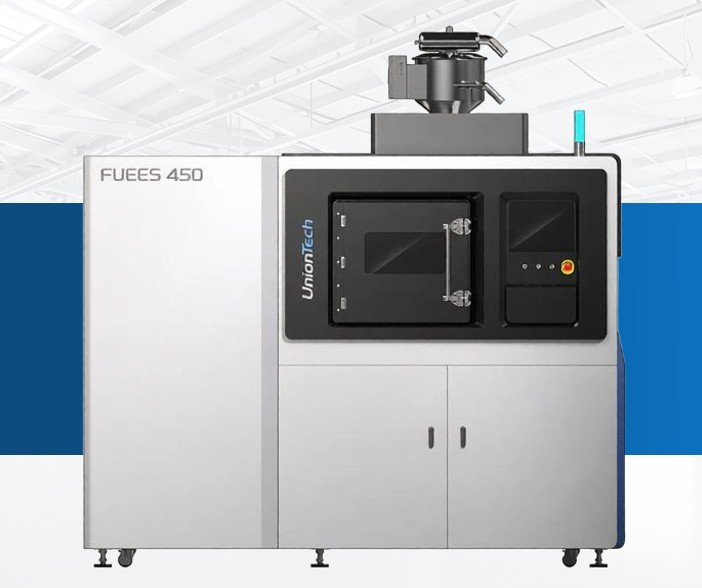
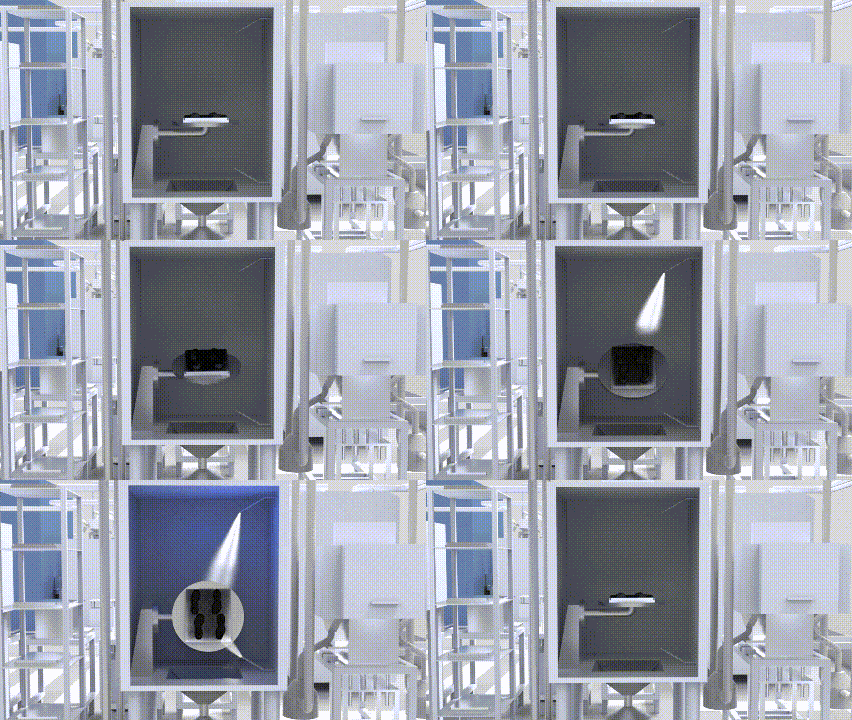
As the operational core of the production line, this zone houses a synchronized cluster of Fuees450 six-laser metal 3D printers, fully integrated with an automated powder recirculation system. The Fuees450’s standardized 15-minute build chamber exchange cycle is precisely synchronized with the line’s takt time—eliminating manual intervention and establishing a deterministic physical foundation for downstream material flow.
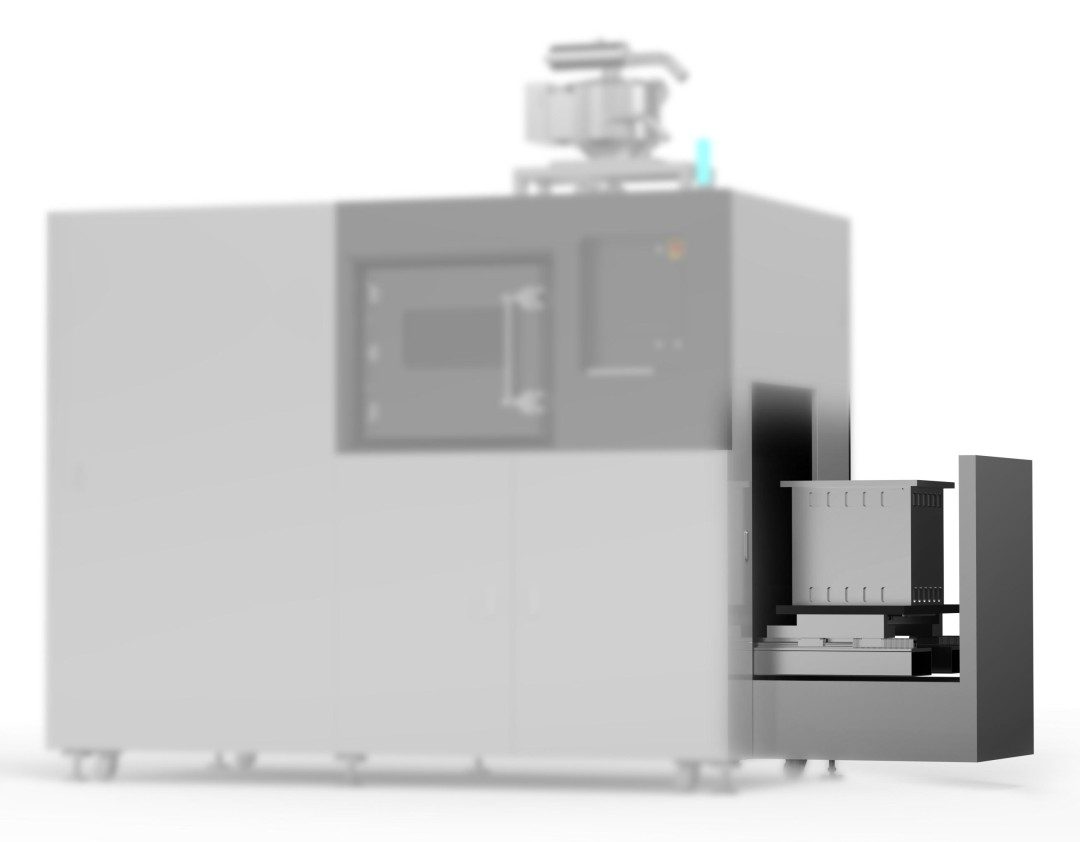
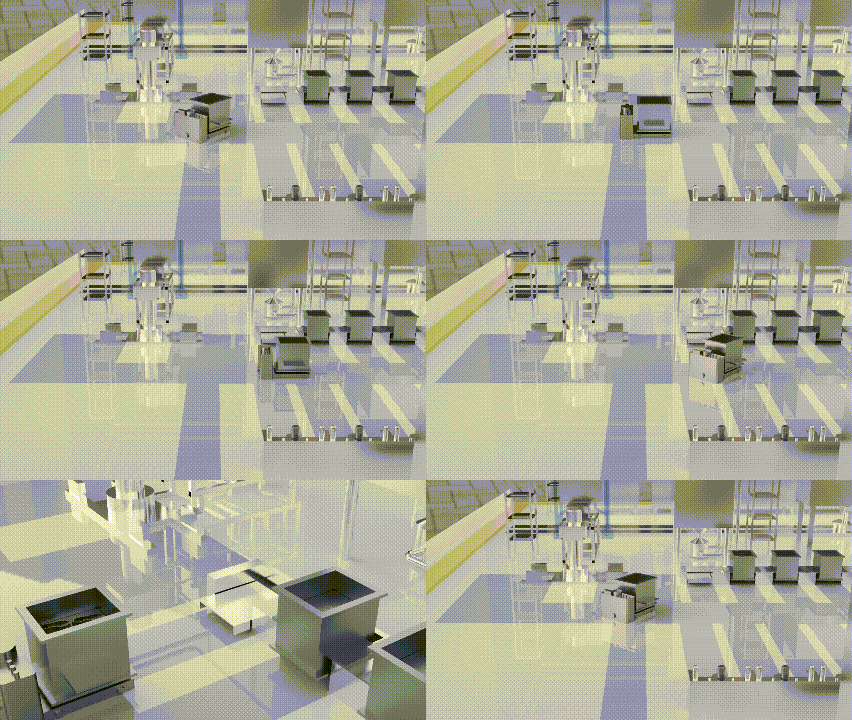
Manual material handling—including cart transportation and heavy lifting—is fully eliminated. Automated Guided Vehicles (AGVs) execute precision scheduling of build chambers with ±5 mm positional accuracy. Rail-Guided Vehicles (RGVs) perform part retrieval and inter-station transfer, enabling seamless, uninterrupted flow of Fuees450 build chambers to downstream stations—thereby eliminating both manual lifting hazards and inter-station waiting time.
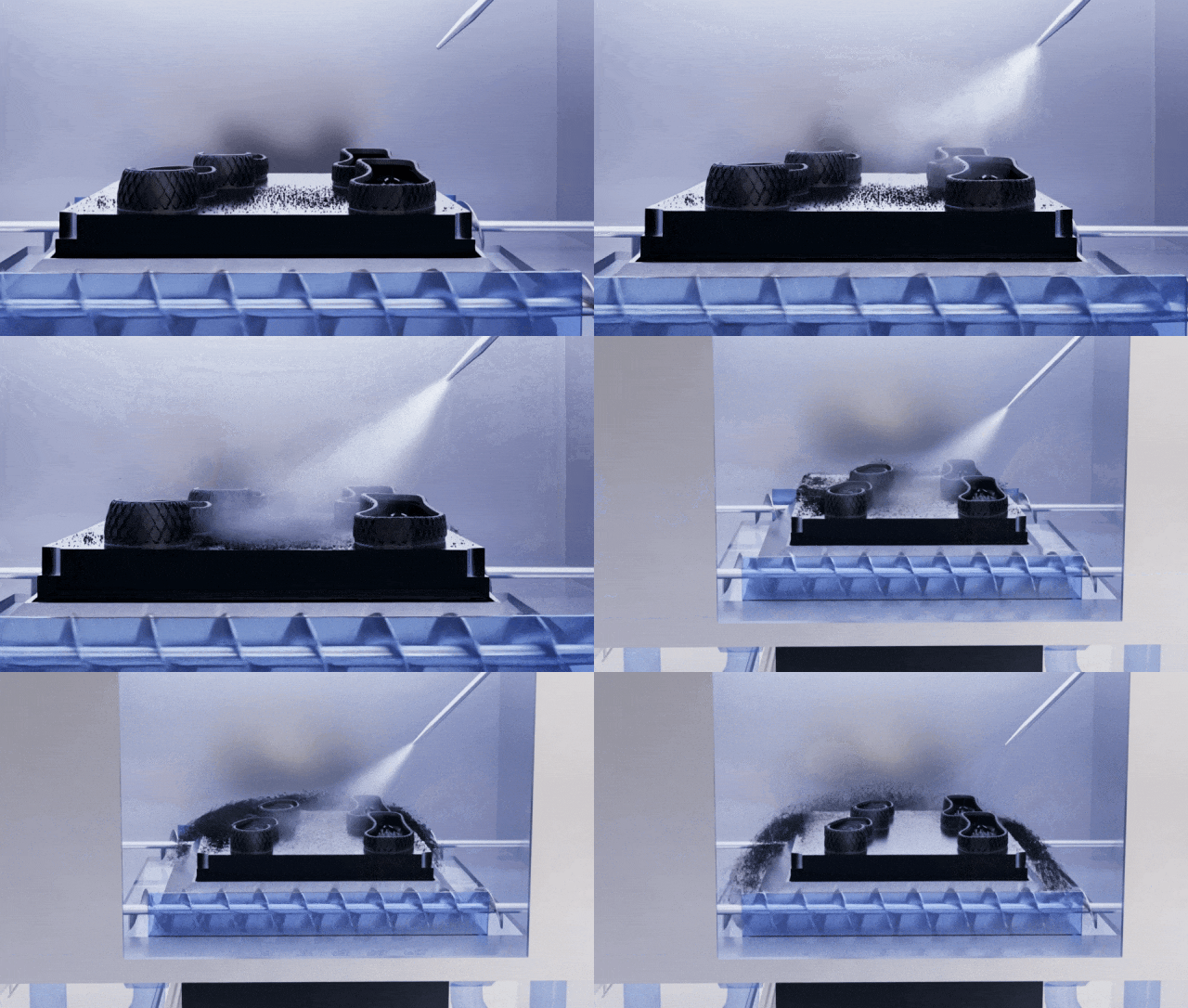
This zone integrates dedicated powder removal systems (Units A and B), vacuum heat treatment furnaces, high-precision 3D scanning inspection stations, and wire electrical discharge machining (EDM) cutting equipment. Parts undergo fully automated, sequential processing—from powder removal through heat treatment and dimensional verification to final part separation—eliminating inter-process waiting time and maintaining metal powder in a rigorously controlled closed-loop recirculation system across all operational stages.
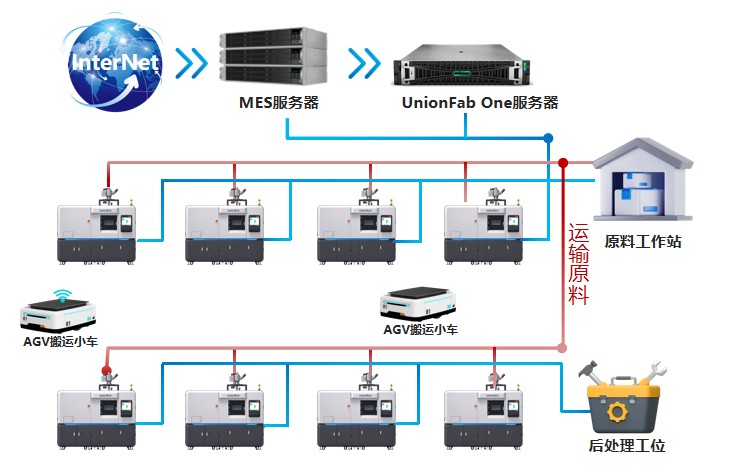
The core enabler of an automated production line resides not in robotic hardware, but in end-to-end data integration. The solution implements a standardized four-tier architecture—comprising Equipment, Control, Monitoring, and Enterprise layers—to unify heterogeneous data streams from sensors, actuators, and industrial controllers. Within this architecture, the Monitoring layer, hosted on the UT ONE software platform, delivers real-time equipment health monitoring, closed-loop process control, and statistical quality analysis. The Enterprise layer, integrated with a certified Manufacturing Execution System (MES), enables bidirectional synchronization with production planning, shop-floor order execution, and full-lifecycle data traceability.
Within this integrated data loop, plant managers gain real-time visibility into the operational status of each Fuees450 printer, the end-to-end material flow trajectory of every powder batch, and the execution progress of each production order. This capability enables automated, rule-based task dispatching and full-lifecycle quality traceability—from raw material certification through in-process monitoring to final inspection and delivery documentation. Consequently, production equipment transitions from isolated, statically assigned assets into dynamically managed, quantifiably optimized components of a unified manufacturing system.
A future-ready production line must integrate technological excellence with demonstrable commercial viability. Based on UnionTech’s validated economic model for a 20-unit Fuees450 metal additive manufacturing line, the automation solution delivers quantifiable improvements across four strategic dimensions:
· Optimized Labor Allocation:
Automated execution of powder transfer, post-build chamber cleaning, and build chamber exchange reduces direct labor requirements and delivers sustained reduction in total labor.
· Enhanced Operational Efficiency:
Elimination of manual handoffs and inter-station waiting reduces total throughput time and enhances Overall Equipment Effectiveness (OEE) through improved availability, performance, and quality rates.
· Guaranteed Safety:
Minimization of direct personnel exposure to metal powder mitigates inhalation and dermal hazards, thereby strengthening compliance with occupational health and safety regulations.
· Consistent Quality:
Reduction of process variability attributable to manual interventions ensures consistent batch-to-batch quality performance and increases first-pass yield.
The strategic objective of smart manufacturing is the realization of an unmanned, environmentally controlled, and continuously operating production facility. UnionTech’s automation solution supports a modular, phased deployment approach: clients may initiate implementation with the Standard Edition—comprising automated printing, build chamber exchange, powder recovery, and inter-process material transfer—to rapidly validate operational and economic benefits; subsequent expansion to the Flagship Edition—integrating in-line heat treatment, automated 3D dimensional inspection, precision wire-EDM cutting, and MES-driven production orchestration—is enabled by scalable architecture and seamless data interoperability.
Built upon the Fuees450 metal additive manufacturing platform as its core processing unit and structured around the integrated automated line as its operational backbone, UnionTech empowers manufacturers to evolve metal 3D printing from a functional prototyping capability into a validated, high-reliability mass production process.

在线咨询
微信咨询
 微信扫码咨询
电话咨询